$55,000
Revenue Generated in 30 Days
Here's exactly how we did it — and how you can too.
I am certain this will end up making you money.
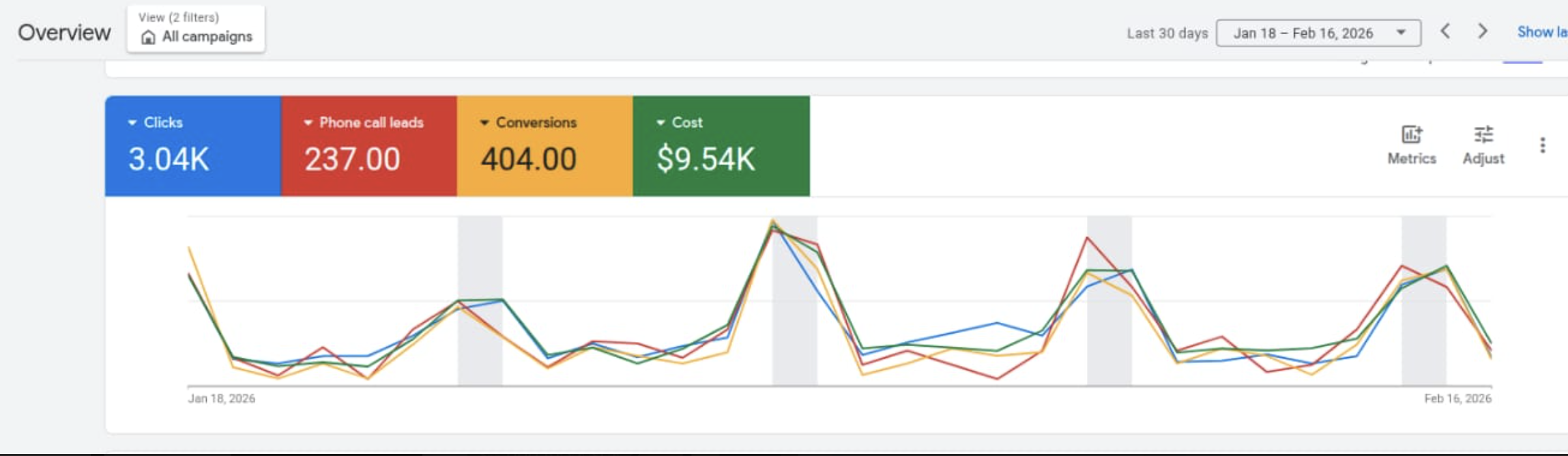
The dashboard above shows 237 tracked phone calls and 404 total configured Google Ads conversions (phone calls, form submissions and other tracked actions). Calls and conversions are different metrics, and not every conversion represents a booked job. Revenue is booked revenue reported by the client.
All of the guys who are junk removal owners and tell you what works for marketing are usually wrong.
They understand the business really well.
But they don't understand different markets.
A California / LA company is going to face a lot of differences compared to a Wyoming-based company.
Demographics changeSeasons are differentCompetition is differentSearch behavior is different
Marketing only works when there's a full understanding of each specific market.
My name is Ethan Smith and I'm a junk removal marketer.
We only work with junk removal companies — no other industries.
That means everything we test, optimize, and scale is specifically built around this business model.
I've been doing this for over a year now and working with some of the top junk removal companies across the U.S.
I've worked with clients in oil field towns in Texas where there are 200 people in the town... And I've worked in some of the most booming cities in the country.
Different markets. Same system.
And we did 5 specific things to generate this $55,000 in 30 days.
There's also a bonus at the end that most companies never think about — and it directly increases close rate.
1
2
3
4
5
We Focused Only on High-Intent Searches.
No boosted posts.
No brand awareness campaigns.
We targeted people actively searching:
"Junk removal near me."
"Furniture removal."
"Hot tub removal."
These are buyers.
Not browsers.
But targeting alone isn't enough...
Because if you structure it wrong, you still lose money.
1
2
3
4
5
We Structured Campaigns by Service Type.
Most junk removal companies lump everything into one campaign.
We didn't.
Furniture removal had its own campaign.
Construction debris had its own campaign.
Appliance removal had its own campaign.
Each service had different messaging and different economics.
And the reason that matters becomes very clear in step four.
1
2
3
4
5
We Matched Messaging to the Local Market.
This is where most 'gurus' get it wrong.
What works in Los Angeles does not work in Wyoming.
Income levels are different.
Urgency is different.
Competition is different.
Seasonality is different.
We adjusted positioning based on the psychology of that specific area.
And that directly increased conversion rate — without increasing ad spend.
1
2
3
4
5
We Built Pages Designed to Convert — Not Just Websites.
We didn't send traffic to a generic homepage.
We built landing pages specifically for the service being searched.
Clear headline.
Clear offer.
Strong trust signals.
Simple call to action.
No confusion. No distractions.
Just one goal: get the call.
If you increase conversion rate by even 10–15%...
Your cost per booked job drops dramatically — without touching your ad budget.
But none of this works if you don't do step five.
1
2
3
4
5
We Tracked Everything.
Calls.
Forms.
Cost per lead.
Cost per booked job.
Revenue per campaign.
If you don't know your numbers, you're guessing.
And if you're guessing, scaling becomes gambling.
We knew exactly what a job cost us.
So when it was profitable, we scaled.
When it wasn't, we adjusted.
That's how you turn ads into a system instead of a gamble.
BONUS
Speed of Follow-Up.
This is the part almost everyone ignores.
If you don't call leads immediately, your cost per job skyrockets.
The faster the response time, the higher the close rate.
Most companies think their ads are broken.
In reality, their follow-up is.
Now here's the truth.
You see content like this.
You think, “I should fix my marketing.”
And then you go back to running jobs. Managing crews. Putting out fires.
Because you don't have time to build, test, track, optimize, and scale a system like this.
That's why we do it for you.
Google Ads
Landing Pages
Tracking
Optimization
Scaling
You focus on running your trucks.
We focus on filling them.
Want to see what this would look like in your market?
Book a Call to Break Down This Strategy for Your Area